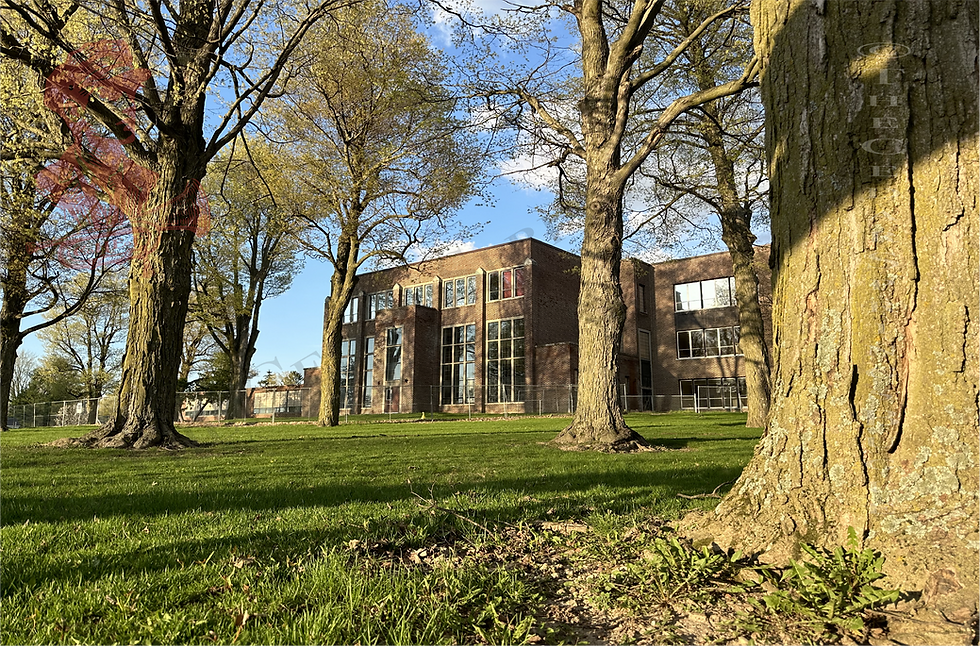
When We Reach The Top Of The Hill

Updated: Apr 26
This week, the school board voted to demolish the Hilltop building. I know you already know, but I had to begin this editorial somehow.
I covered the decision and wrote about the costs, the planning and what comes next. But what has stayed with me isn't so much the vote itself as the thought of all the days that building held.
One hundred years is a long time for any structure to stand in place. Long enough for generations to pass through it without thinking much about the fact that they were part of a long line. My own grandmother graduated high school at Hilltop, and my parents attended junior high there. So when I say generations, I mean literal generations.

It's not hard to imagine the rhythm of life inside those walls. Mornings when kids walked in with brand new backpacks at the start of the school year, nervous but pretending not to be. Afternoons when the final bell sent everyone out the doors in a rush. Random Tuesdays that no one remembers clearly now, but once felt important in the way only childhood days can.
If you attended school at Hilltop, you probably don't remember everything. But you may remember fragments, such as a teacher’s voice or how it would get decorated around Halloween, Thanksgiving, and Christmas. Personally, I remember the way the building seemed enormous when I was young and somehow smaller once I grew.
So, that's what strikes me. The days gone by that were held within the building. Not the vote. The vote was, quite honestly, unsurprising despite the lingering sentimentality of it all.
But sentimentality comes at a price. And Cedar Springs has never been a community that approves spending easily. Looking back over the past twenty years, school related bond proposals have often struggled unless residents were convinced they were absolutely necessary. In 2007, an operating millage increase failed with 49.15 percent voting yes. In 2011, a sinking fund was rejected at 47.91 percent before passing the following year at just 50.62 percent. Again, in 2019, a construction bond received only 43.64 percent support and failed, only to pass in 2020 with a mere 50.21 percent. Even just this past November, a regional enhancement proposal fell short at 47.42 percent.

If that pattern says anything about this town, it's this: Cedar Springs requires convincing and is not quick to approve new spending. Nor does it consist of sentimental voters.
When viewed in that light, the decision about Hilltop doesn't feel so sudden anymore. It feels like the end of a conversation that has been circling for decades...and it has.
The question of whether it could or should be saved is not new. In 1985, former Bugle founder and publisher Niels Andersen wrote, “Why A New School? Can’t Hill Top [sic] Be Saved?” He went on to argue that the building was sturdy and could stand for another 60 years. Even then, the tension between preservation of sentiment and practicality was present.
A building can hold thousands of small, unremarkable days, and those days subtly shape lives. The children who once moved through those hallways are adults now. Some of them have children of their own attending school in other buildings like Beach or Cedar View. And today, those buildings are holding thousands of small, unremarkable days, subtly shaping the lives of those who attend.
Hilltop stayed in place while everything changed around it. Now it will change too.
When Hilltop eventually comes down, it will leave only a new skyline. Not the memories of the people who passed through it. No, those will remain in conversations, in old photographs, at the invaluable resource of the Cedar Springs Museum which you should all be visiting, and in the simple sentence, “I went to school there.”
That’s it. There is no dramatic lesson here. Just the recognition that places matter because of what happened inside them, not because they last forever.
Time does not pause while we decide how we feel about it. It keeps moving.
Hilltop had a long chapter in Cedar Springs. One might say it finally reached the top of the hill.
I’ll resist going any further with that.
Regardless, it seems that now is the time to turn the page in the school's and the town's history.
Just like they did one hundred years ago.